
Introduction
As healthcare facilities work to align with AAMI ST108, one truth becomes increasingly clear: water quality isn’t just about treatment—it’s about distribution. Even the most advanced purification system can’t protect a sterile processing department if the water loop that delivers that purified water isn’t designed and maintained correctly. That’s where thoughtful loop design, deadleg minimization, and strategic sampling come into play.
The Water Loop: The Highway for Critical Water
Once water has passed through the treatment train—softeners, carbon beds, RO membranes, UV disinfection, and final filtration—it enters the distribution loop. This loop circulates critical water continuously, ensuring that every point of use receives water that meets the facility’s defined specifications.
A well‑designed loop does three things exceptionally well:
- Maintains flow velocity to prevent stagnation
- Reduces areas where water can sit and grow microbes
- Delivers consistent quality to every connected device
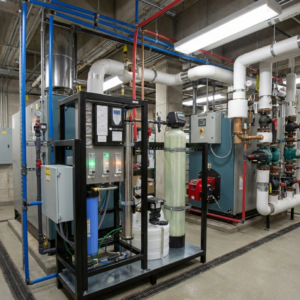
If the treatment train is the engine, the loop is the delivery system—and both must work in harmony.
Deadleg Minimization: Eliminating the Hidden Threats
A “deadleg” is any section of piping where water can slow down, stagnate, or stop moving entirely. These stagnant pockets become ideal environments for microbial growth and biofilm formation. Once biofilm takes hold, it can seed the entire loop, undermining the purity of the water feeding washers, ultrasonic cleaners, and sterilizers.
ST108 emphasizes minimizing deadlegs because they are one of the most common—and preventable—sources of contamination.
How water treaters reduce deadlegs:
- Short branch lengths to equipment
- Continuous recirculation through all active lines
- Elimination of unused or abandoned piping
- Strategic placement of valves and tees
- Designing loops in a true “ring” configuration rather than long, branching networks
The goal is simple: keep water moving everywhere, all the time.
Sampling at the End of the Treatment Train: The First Checkpoint
Before water ever enters the loop, it must be verified. That’s why ST108 encourages sampling at the end of the treatment train—the point where critical water is produced but before it’s distributed.
This sample point helps answer a crucial question: Is the treatment system performing as designed?
Typical tests at this location include:
- Conductivity or resistivity
- Hardness
- Total organic carbon (TOC)
- Microbial counts
- Endotoxin (when required)
- Silica, chloride, and other ions of concern
If the water fails here, the issue is upstream—membranes, filters, or softeners—not the loop.
Point‑of‑Use Testing: The Final Word on Water Quality
Even if the treatment train is perfect, the loop can still introduce problems. That’s why point‑of‑use (POU) sampling is essential. These are the locations where water actually touches the devices used for cleaning and sterilization.
Common POU locations include:
- Washer‑disinfectors
- Ultrasonic cleaners
- Endoscope reprocessors
- Steam generator feed lines
- Final rinse outlets
POU testing verifies that the loop is delivering water that meets specifications at the moment it’s needed. It also helps identify issues like:
- Biofilm growth in the loop
- Stagnation in branch lines
- Filter failures
- Temperature or pressure inconsistencies
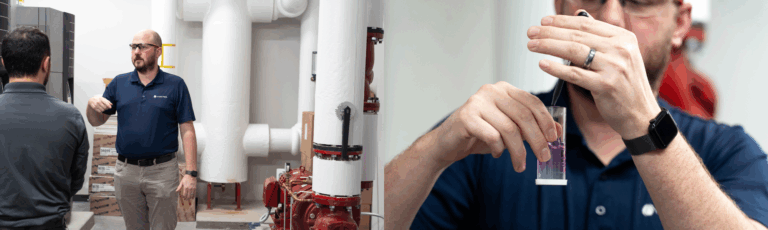
Together, end‑of‑train and POU sampling create a complete picture of system performance.
A Strong Loop Means Strong Outcomes
In an ST108 environment, water quality is no longer a background concern—it’s a core component of patient safety and instrument reliability. Thoughtful loop design, aggressive deadleg minimization, and strategic sampling ensure that critical water stays critical from the moment it’s produced to the moment it’s used.
When the loop is healthy, the entire sterile processing workflow benefits. And when it’s not, the water treater is the first line of defense in diagnosing and correcting the issue. Learn more about Hydrotrue’s ST108 compliant offerings.